|
History Of Sealand
During World
War II, the United Kingdom decided to establish a number of military
bases, the purpose of which was to defend England against German air
raids. These sea forts housed enough troops to man and maintain
artillery designed to shoot down German aircraft and missiles. They
were situated along the east coast of England on the edge of the
English territorial waters.
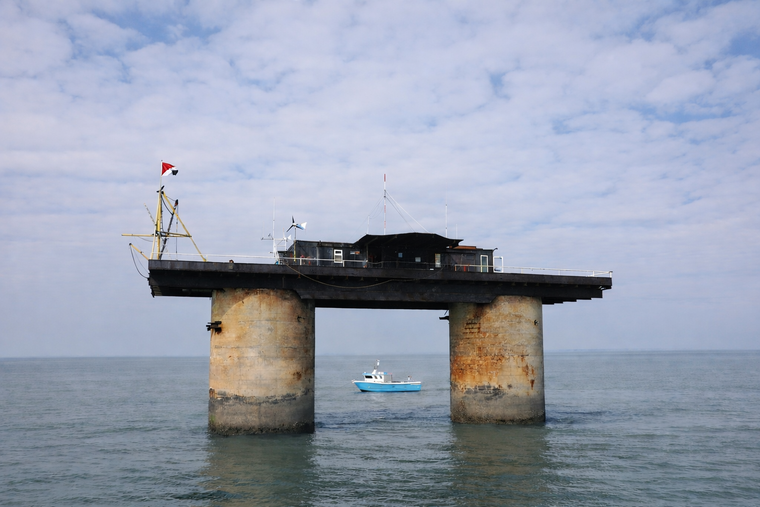
One of these
bases, consisting of concrete and steel construction, was the famous
royal fort Roughs Tower situated slightly north of the estuary region
of the Thames River. In contrast to the original plan to locate the
tower within the sovereign territory of England, this fortress was
situated at a distance of approximately 7 nautical miles from the
coast, which is more than double the then applicable 3 mile range of
territorial waters; to put it briefly, this island was situated in the
international waters of the North Sea.
After WWII
ended, the troops were withdrawn from all bases by the British
Admiralty. None of them was ever used by the United Kingdom again,
leaving the forts deserted and abandoned. Except for the aforementioned
fortress, the bases were subsequently pulled down. This resulted in the
portentous uniqueness of the fortress. Fort Roughs Tower, situated at
the high seas, had been deserted and abandoned, res derelicta
and terra nullius. From a legal point of view, it
therefore constituted extra-national territory.
The Birth of
Sealand
This paved the
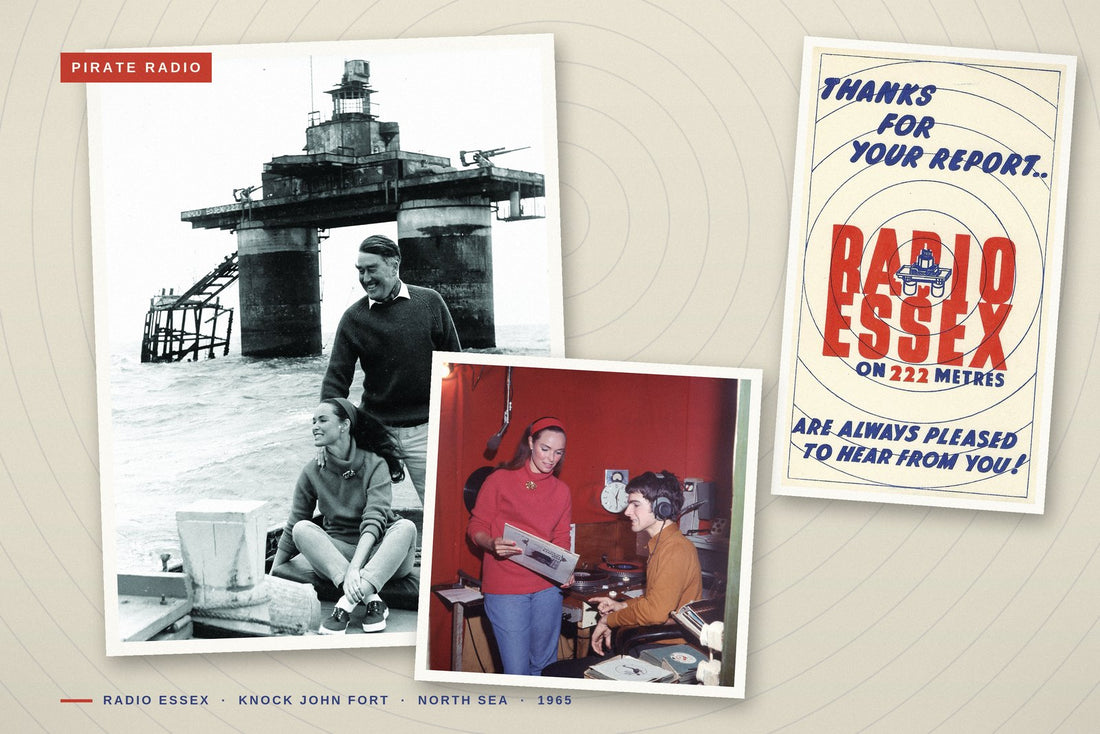
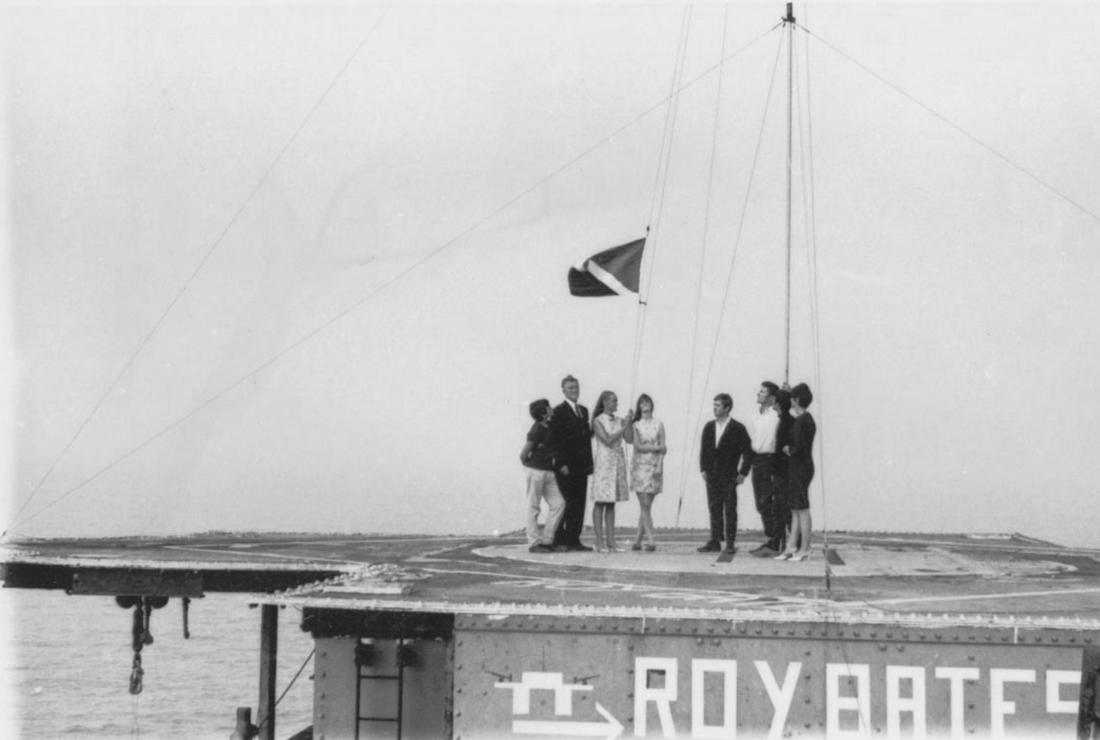
way for occupation. On 2 September 1967, former English major Paddy Roy
Bates formally occupied the island and settled there with his family.
After intensive discussions with skillful English lawyers, Roy Bates
proclaimed the island his own state. Claiming jus gentium,
he bestowed upon himself the title of Prince and the title of Princess
to his wife and subsequently made the state the Principality of
Sealand. Roy Bates, henceforth Roy of Sealand, exerted state authority
on the island and thus was an absolute sovereign. The royal family and
other persons that have declared loyalty to Sealand have occupied
Sealand ever since.
Initial
Challenge to Sealand's Sovereignty
By late 1968,
the British navy had become aware of the new situation off the coast of
England. They were interested in terminating the state of affairs
brought about by an error committed by the most senior military
authorities without causing too much uproar.
Units of the
navy entered the territorial waters claimed by Roy of Sealand. As he
was aware of his sovereignty, Roy of Sealand threatened the navy by
undertaking defensive activity. Shots were fired from Sealand in
warning.
Since Roy of
Sealand was still an English citizen, he was thus accused of extensive
crimes in Britain and was summoned to an English court. The result of
this lawsuit in Chelmsford, Essex was a spectacular success for
Sealand's claim to sovereignty. In its judgment of 25 November 1968,
the court declared that it was not competent in Roy of Sealand's case
as it could not exert any jurisdiction outside of British national
territory. This is the first de facto recognition
of the Principality of Sealand. English law had ruled that Sealand was
not part of the United Kingdom, nor did any other nation claim it,
hence Prince Roy's declaration of a new Sovereign State was de
facto upheld.
Building a New
Nation
Seven years
later on 25 September 1975, Roy of Sealand proclaimed the Constitution
of the Principality. Over time, other national treasures were
developed, such as the flag of the Principality of Sealand, its
national anthem, stamps, as well as gold and silver coins launched as
Sealand Dollars. Finally, passports of the Principality of Sealand were
issued to those who had helped Sealand in some way, though they were
never for sale.
Sealand Fights
Off Invaders (and Wins a War)
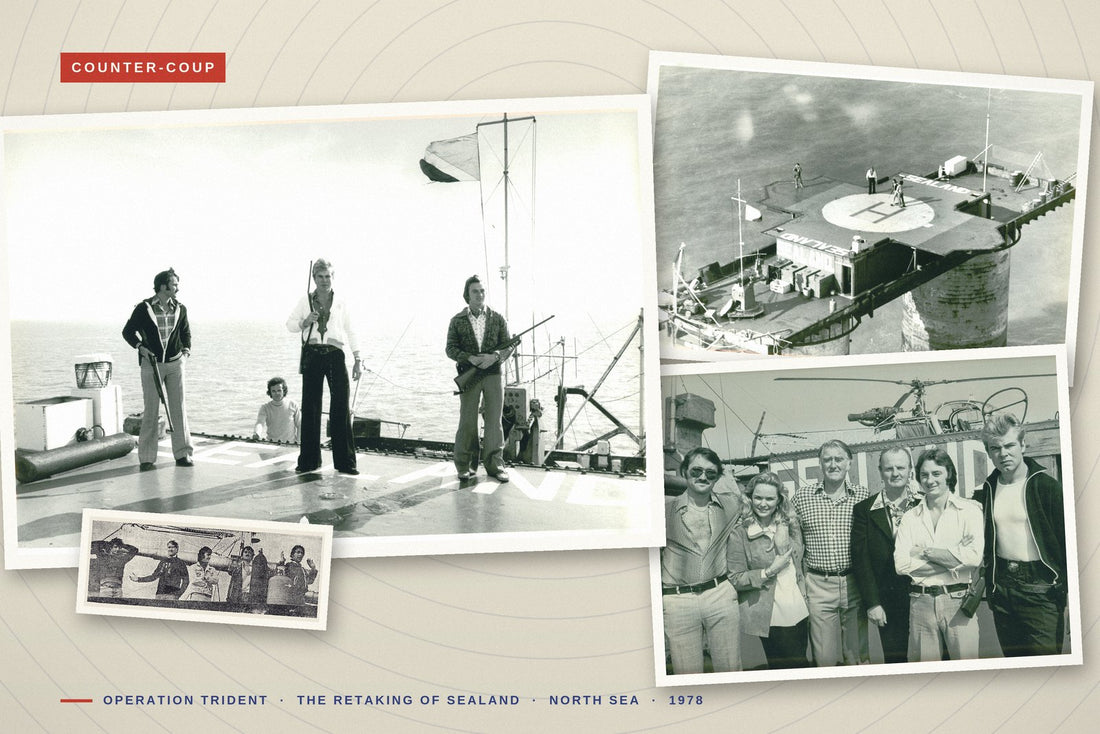
In August of
1978, a number of Dutch men came to Sealand in the employ of a German
businessman. They were there to discuss business dealings with Sealand.
While Roy was away in Britain, these men kidnapped Prince Roy's son
Michael, and took Sealand by force. Soon after, Roy recaptured the
island with a group of his own men and held the attackers as prisoners
of war.
During the time
that he held the prisoners, the Governments of the Netherlands and
Germany petitioned for their release. First they asked England to
intervene in the matter, but the British government cited their earlier
court decision as evidence that they made no claim to the territory of
Sealand. Then, in an act of de facto recognition of Sealand's
sovereignty, Germany sent a diplomat directly to Sealand to negotiate
for the release of their citizen.
Roy first
released the Dutch citizens, as the war was over, and the Geneva
Convention requires the release of all prisoners. The German was held
longer, as he had accepted a Sealand Passport, and therefore was guilty
of treason. Prince Roy, who was grateful that the incident had not
resulted in a loss of life, and did not want to bloody the reputation
of Sealand, eventually released him as well.
Extension of
Territorial Waters
On 1 October,
1987, Britain extended its territorial waters from 3 to 12 nautical
miles. The previous day, Prince Roy declared the extension of Sealand's
territorial waters to be a like 12 nautical miles, so that right of way
from the open sea to Sealand would not be blocked by British claimed
waters. No treaty has been signed between Britain and Sealand to divide
up the overlapping areas, but a general policy of dividing the area
between the two countries down the middle can be assumed. International
law does not allow the claim of new land during the extension of sea
rights, so Sealand's sovereignty was safely "grandfathered" in. Britain
has no more right to Sealand's territory than Sealand has to the
territory of the British coastline that falls within its claimed 12
nautical mile arc.
Some nations
might have tried to use this as an excuse to try to claim all of the
territory of the weaker and not well recognized nation regardless of
international law, however, this has not been the case. Britain has
made no attempt to take Sealand, and the British government still
treats it as an independent State. Prince Roy continues to pay no
British National Insurance during the time he resides on Sealand
subsequent to a ruling by the British Department of Health and Social
Security's solicitor's branch. Also, there was another fire arms
incident in 1990 when a ship strayed too near Sealand and warning shots
were again fired. The ship's crew made complaints to British
authorities and a newspaper article ran detailing the incident. Yet
despite Britain's severe prohibition of firearms, British authorities
have never pursued the matter. This is a clear indication that
Britain's Home Office still considers Sealand to be outside their zone
of control.
Fake Sealand
Passports
In 1997, forged
Sealand passports started tuning up around the world. Some of these
were used to open bank accounts under false names in various countries.
Since few people have ever seen a legitimate Sealand passport (less
than 300 exist today) it was difficult for these to be easily detected
as forgeries. The source of these forgeries was traced back to the same
German man who was involved in the earlier attempt to take Sealand by
force. Dubbing himself Minister of Finance, he had created a fake
Sealand Business Foundation and boasts that he has sold over
150 000 fake Sealand Passports to all comers. Thus there are
now unfortunately 500 times more forged Sealand Passports in
circulation than real ones. Many of the forged passports were
apparently sold to people leaving Hong Kong at the time of Chinese
reoccupation for USD 1 000 each.
Current Views
of the Principality of Sealand
The current
government of the Principality of Sealand considers itself to be
sovereign, and to have been recognized de facto as
such on the basis of the aforementioned statements by multiple world
governments. It states the following:
"The
Principality of Sealand recognizes jus gentium and has undertaken to
regulate any activity with a view to compliance with jus
gentium and international law or to have it regulated."
The existence
of the Principality as an independent State and the de facto
recognition of its sovereignty has been demonstrated time and time
again over the last three decades by European and other States and in
particular by its nearest neighbour, the United Kingdom. Britain has
stated clearly and has demonstrated on a number of occasions either
that it has no jurisdiction within Principality territorial limits or
that it has no interest in events that have taken place within the
Principality.
Moreover, a
number of independent legal experts have weighed carefully all
arguments for and against Sealand sovereignty and unanimously have
agreed that jus gentium applies as a basic principle underpinning the
independence of the Principality. This position is further supported by
de facto events which demonstrate that reality. On many occasions,
other States have either left Sealand alone to deal internationally
with matters critical to its National interest, or have recognised
Sealand as the legal and administrative authority over all activities
within its territorial limits.
Even today, the
United Kingdom government recognises, inter alia, residency or work in
Sealand as an overseas activity.
The Internet
Comes to Sealand
Whilst Sealand
has been the pride and joy of Prince Roy and his family for well over
30 years, his recent poor health has caused him fundamentally to review
the arrangements which have been in place for decades and to look to
the future of his Principality. Consequently, his son Prince Michael
was appointed Prince Regent as Sovereign pro tempore by Royal Decree in
1999.
Since that
time, the Royal Family has struck a deal with HavenCo Limited,
and that company now leases exclusively its offices and operations
centres in Sealand, where it offers, and is able to offer, unparalleled
security and independence to users who wish to take advantage of its
Internet colocation services.
The presence of
an active and rapidly growing high-tech internet industry in Sealand
has changed the character of the Principality; once more, Sealand rings
with the sound of voices, boasts regular support ferry services, and is
host to a growing and dynamic population.
Because of the
high security required to support HavenCo's operations, access to
Sealand remains highly restricted and no public visits are allowed.
Further information or specific queries may be addressed to the Bureau
of Internal Affairs (burint@sealandgov.org)
at SEALAND 1001, Sealand Post Bag, IP11 9SZ, UK.
|